Low‐count whole‐body PET/MRI restoration: an evaluation of dose reduction spectrum and five state‐of‐the‐art artificial intelligence models
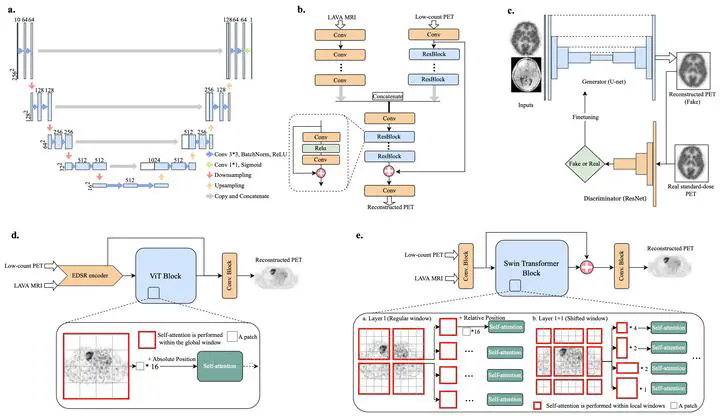 Image credit: Unsplash
Abstract
In this multicenter study, five AI models were investigated for restoring low-count whole-body PET/MRI, covering convolutional benchmarks — U-Net, enhanced deep super-resolution network (EDSR), generative adversarial network (GAN) — and the most cutting-edge image reconstruction transformer models in computer vision to date — Swin transformer image restoration network (SwinIR) and EDSR-ViT (vision transformer). The models were evaluated against six groups of count levels representing the simulated 75%, 50%, 25%, 12.5%, 6.25%, and 1% (extremely ultra-low-count) of the clinical standard 3 MBq/kg 18F-FDG dose. The comparisons were performed upon two independent cohorts — (1) a primary cohort from Stanford University and (2) a cross-continental external validation cohort from Tübingen University — in order to ensure the findings are generalizable. A total of 476 original count and simulated low-count whole-body PET/MRI scans were incorporated into this analysis.
Add the publication’s full text or supplementary notes here. You can use rich formatting such as including code, math, and images.

Peng-Cheng Wang
PhD Student in USC
My research interest is in Biomedical Artificial Intelligence, focusing on the interdisciplinary areas that encompass Machine Learning, Computer Vision, Signal and Image Processing, Medical Image Analysis, Biomedical Imaging (MRI), and data science.